Search This Blog

Showing posts with label Dodgers. Show all posts

Sunday, April 26, 2015

Bob's Books - The Last Good Season by Michael Shapiro

Michael Shapiro’s The Last Good Season looks at 1956: the year after the Brooklyn Dodgers won their only World Series. With the same cast of characters, the Dodgers spent most of the season chasing the Milwaukee Braves, edging them for the pennant by just one game. Ted Kluszewski’s Cincinnati Reds finished only two games back.

Facing (naturally) the Yankees once again in the Fall Classic, they ran into Don Larsen’s unlikely perfect game and saw league MVP and Cy Young Award winner, Don Newcombe, hammered in the game seven loss.

This book interweaves three stories: First, the actual on-field play of the boys of summer.

It’s also the story of the changes in Brooklyn, as the ethnic makeup was undergoing a transformation. And that change played a part in the third story: that of Walter O’Malley’s attempt to get a new stadium, leading to the move to Los Angeles.

Though getting a bit long in the tooth (Jackie Robinson would be sold, then retire after the Series), the offense dominated National League pitching, while Don Newcombe and Clem Labine started and finished wins. Perhaps because so much has been written about these fifties Brooklyn Dodgers, the actual baseball part doesn’t make up quite as much of the book as expected. There’s still plenty there, but it’s not as big a part of the whole as the title leads one to believe.

There are long passages looking at the experiences of Brooklynites and the changes going on in the borough. I found these to be the least interesting parts of the book.

There is much about O’Malley’s attempt to build a new stadium in Brooklyn, and about powerful  New York City official Robert Moses’ lack of interest in helping O’Malley on the latter’s terms. Whether or not O’Malley’s domed stadium and site selection was actually feasible, Robert Moses wasn’t interested in facilitating the project. In the end, he tried to push the Dodgers into a site in Flushing, which a few years later came to host Shea Stadium.

Every book seems to take sides. While Shapiro isn’t particularly sympathetic to O’Malley, he clearly states, “In the end, Robert Moses is the bad guy in this story.” I happen to be in the camp that there is much blame to be assigned to both sides. But O’Malley wanted to improve his business, couldn’t get what he wanted, and went somewhere else where he could get it. That’s a simplified view, but that doesn’t make it any less accurate.

I think that this is a pretty good book about the second-to-last season of the Brooklyn Dodgers, with quite a bit of information on the power struggle for a new ballpark. One interesting tidbit is that Los Angeles officials were in Ebbets Field, wooing Clark Griffith of the Washington Senators when O’Malley sent a note down, saying he wanted to talk to them. The Senators, of course, moved to Minneapolis and became the Twins.

I give it four stars, with its strength being the O’Malley – Moses tussle.

Tuesday, April 14, 2015

Jackie Robinson Day is Tomorrow (April 15, 2015)

Tomorrow, April 15, is 2015 Jackie Robinson Day in MLB. I've written about Robinson several times here on the blog. The Dodgers are hosting the Mariners for a game on ESPN2. It's the 2015 Civil Rights Game and there will be all kinds of tributes.

Sharon Robinson (Jackie's widow), Don Newcombe, Sandy Koufax and Roy Campanella's daughter will all be involved in the throwing out the first pitch.

Tune in and remember Jackie. You can use the search line above to find all my Robinson, Newcombe and Dodgers related posts on the site.

BTW, I do pretty much all my posting these days over at my current blog, Almost Holmes. I'd like to free up some time do some more baseball writing here this summer, though.

Wednesday, June 18, 2014

This Day In Baseball (Throwback Thursday) History , June 19,1940 - Ducky Medwick Beaned by Cards

The Slide
In 1940, baseball players did not wear batting helmets. Batters stood in there against pitchers throwing ninety-plus miles per hour, putting life and limb at risk. It’s amazing that only one player (Ray Chapman) died from being hit by a major league pitch.

In 1940, Cardinals outfielder Joe ‘Ducky’ Medwick was one of the best players in the game. After averaging .352 over the prior two seasons, he won the coveted triple crown in 1937, going .374 with 31 homers and 154 RBIs. Not surprisingly, he won the MVP award that year.
Landis ejects Medwick
The next year he hit .322 and led the league in doubles and RBIs. For this, he was rewarded with a 20% pay cut (in those days of the Reserve Clause, players took what was offered or had to quit baseball and get a real job). The outfielder voiced his displeasure over this. Medwick, who was generally unpleasant, had gotten into fights with several teammates over the years. But his lack of popularity wasn’t limited to St. Louis.

In Game 7 of the 1934 World Series, Medwick had slid into third base and was spiked by Tiger Marv Owen. Medwick responded by kicking Owen in the stomach with both his spikes and started a brawl. When Medwick took his position in left field, fans threw so much debris (bottles, fruit, rolled up hot dog buns) the game couldn’t be resumed. Commissioner Landis had a confab and ended up removing Medwick from the game (which the Cardinals won handily, surely contributing to the surly disposition of Tigers fans).
Joe Medwick was disliked by teammates, other players and fans. And since he was vocally unhappy with Cardinals owner Sam Breadon over his salary, he had an enemy at the top. Breadon had a low tolerance level for players he considered malcontents. Especially when it involved ungrateful attitudes towards their salaries.

Medwick, Durocher and Davis
On June 12, 1940, he was traded to the Brooklyn Dodgers along with pitcher Curt Davis. However, his problems with the Cardinals were about to get worse. On the morning of June 18, Medwick along with manager Leo Durocher, had a verbal confrontation in a hotel elevator with his ex-teammate, pitcher Bob Bowman, who yelled. “I’ll take care of you! I’ll take care of both of you!”
The following day, the first three Dodger batters got hits (two of them already scoring). Bowman then beaned Medwick in the temple and sent him to the hospital on a stretcher. Leo Durocher had to be restrained while team President Larry MacPhail went after Bowman and reportedly challenged the Cardinals bench to a fight.

That's Bowman on the left.
The pitcher was removed from the game and escorted by police back to the team’s hotel. Medwick (who had a concussion but no skull fracture) tried to get out of bed to go after Bowman but was kept in the hospital.

MacPhail fruitlessly tried to have National League President Ford Frick ban Bowman for life. The Old Redhead, known for his emotional responses to, well, just about everything, also attempted to have Bowman arrested for assault. The Brooklyn district attorney investigated the affair and found no evidence of criminal intent on the pitcher’s part.

Medwick, who was expected to miss three weeks, was back in the lineup in one. Players were rushed back from injuries as a matter of habit (wrecking several promising careers over the years).
Though he helped the Daffiness Boys to their first World Series in over two decades in 1941, Ducky Medwick was never the same after being hit by that pitch. Before being traded to the Dodgers, he had hit .336 in his Cardinals career, leading the league in runs, hits, doubles, triples, homers, RBIs or batting average a total of twelve times. He would never lead the league in any category again after The Pitch.

He hit .300, .318 and .300 for Brooklyn from 1940 through 1942: Which wasn’t bad, but certainly not up to his pre-beaning levels. He was batting only .272 when he was traded to the New York Giants during the 1943 season. Medwick was still a good hitter, but he was nowhere near one of the best players in the game. He had a brief return to form in 1944, hitting .323 for the Giants, but he would never again play in 100 games and after the Cards released him in 1948, he spent three years in the low minors as a manager-player.

Reportedly, upon his retirement, an ex-teammate said, “When he dies, half the National League will go to his wake just to make sure that son-of-a-bitch is dead.”


Likely due to Medwick’s brusque (read: rude) attitude towards reporters, he had to wait twenty years to be voted into the Hall of Fame, getting the nod from the Veteran’s Committee in 1968.  He was certainly deserving of the honor, even if pretty much nobody liked him during his career.

Medwick visited the Vatican with a group of servicemen during World War II. The Pope asked each man his vocation in civilian life. Medwick replied, “Your holiness, I’m Joseph Medwick. I, too, used to be a Cardinal.”
BATTING HELMETS – Ray Chapman was killed by a Joe Sewell pitch in 1920. In 1941, Larry MacPhail had his Dodgers wear the first batting helmets in a game. They were essentially the normal cloth caps with a hard liner. Major League Baseball did not make batting helmets mandatory until 1971, though some players were granted a grandfather clause and could continue using the caps with liners. Ear flaps were made mandatory in 1983, but players who had been using flapless helmets were allowed to continue batting without them. Beanings suffered by Medwick, teammate Pee Wee Reese and ‘Pistol’ Pete Reiser resulted in the Dodgers leading baseball to protecting their players with batting helmets.


Pete Reiser after getting beaned


Tuesday, June 10, 2014

RIP Bob Welch - For One Moment...

Bob Welch has passed away from an apparent heart attack. Welch won the Cy Young with 27 wins for Oakland in 1990. No pitcher has won more than 24 games since then.

He struggled with alcoholism during his career, which was unknown until he wrote a book about it in 1981. Obviously, he overcame it.

 But if you're of an age, what stands out was his classic showdown with Reggie Jackson in Game Two of the 1978 World Series. The hard throwing rookie vs. the game's biggest star. It was the kind of moment that makes the World Series The Fall Classic.

 The Confrontation:

As this article tells, Reggie got even in Game Six (that shot almost went to the moon!), but oh, it was a scintillating nine-pitch at bat in Game Two.

Saturday, June 7, 2014

Don Newcombe - Almost a Hall of Famer?


The Dodgers and Yankees met in the World Series in 1947, 1949, 1952, 1953, 1955 and 1956. Brooklyn managed to win only the 1955 match up. The greatest advantage that the Yankees had was their starting pitching. Whether it was Eddie Lopat, Allie Reynolds, Whitey Ford, Bob Kuzava or Don Larsen, the Bronx Bombers always seemed to come up with somebody in big moments (if not for Cookie Lavagetto, Bill Bevens would be included on that list).

During this era, Don Newcombe rose above the other Dodger would-be aces, such as Carl Erskine, Ralph Branca and Johnny Podres (though the latter certainly carried the flag in the 1955 Series). Big Newk missed the 1952 and 1953 seasons, as he was serving his country, fighting in Korea. And his 1954 season was a poor one: it took him a year to get back to form after being released from service.

But in 1949-1951 and  1955-1956, Newcombe went a combined 103-40, with 92 complete games. Those are some impressive numbers for the 1949 Rookie of the Year.

However, he got a reputation as a choker in big games. He went all ten innings against the Phillies on the final day of the 1950 season, with the Dodgers needing a win to force a playoff. But he gave up a three run homer to Dick Sisler in the top of the tenth in the season-ending 4-1 loss (which would have been a win if third base coach Milt Stock had simply held Cal Abrams at third in the bottom of the ninth).

He carried a 4-1 lead into the ninth inning of that famous game three playoff against the Giants in 1951. But he couldn't hold on and he had been relieved by Ralph Branca when Bobby Thomson hit the home run heard round the world.

And in three World Series', he just couldn't get the job done for the Dodgers. He started 5 games, going 0-4 with an ERA of 8.59 and lasting about 4 innings a start.


Yogi Berra hit a pair of two-run
homers off Newcombe in
Game 7 in 1956
In 1956, he won the (very first) Cy Young Award and the NL MVP, going 27-7. But in the World Series he couldn't make it out of the second inning of game two or the fourth in game seven. And he climbed into the bottle after that World Series. His career was effectively done, as he went a combined 37-42 in the four years after that Cy Young season. He spent 1961 in the minors and quit the game.

A Trail Blazer

Newcombe was one of the first black players signed by the Dodgers. He and Roy Campanella played with Nashua of the New England League (B) in 1946 and 1947. Newcombe was dominant, going 33-10 with an ERA well under 3.  He probably would have played in AA ball in 1947 but the Dodgers' two AA teams were in the south and not yet ready to be integrated.

In 1948 he went 17-6 at AAA Montreal and got called up to the Dodgers early in 1949. He was the second black pitcher in the major leagues and the first good one (Dan Bankhead pitched in four games for the Dodgers in 1947).

Close to Cooperstown

Newcombe lost a season or two to baseball's color barrier.

And he lost nearly three peak seasons to the Korean War.

Finally, had Newcombe pitched better in the World Series (especially in 1956), he might well have continued on as one of the NL's top pitchers instead of spiraling into alcoholism.

The third factor was certainly within his control. But if the last two had been a bit different, Don Newcombe might well be in the Hall of Fame today.

He and Justin Verlander are the only players to win the Rookie of the Year, Cy Young and MVP awards.
Four pioneers: Roy Campanella, Larry Doby,
Don Newcombe and Jackie Robinson at the 1949 All Star Game

Friday, June 6, 2014

The Greatest Pitcher You Never Heard Of


Twenty-year old Karl Spooner joined the Brooklyn Dodgers’ Class D farm club in Hornell of the Pennsylvania-Ontario-New York (PONY) League in 1951 He went 10-12 with an ERA of 4.18

By 1954, he had moved up through the C, B and A leagues and started the season with AA Fort Worth in the Texas League. Spooner walked nearly as many as he struck out, but he could dominate, as evidenced by a no-hitter in 1953.

He brought to mind Rex Barney, a young Dodgers fire baller from the previous decade whose fastball was compared to Walter Johnson’s, But Barney had major control issues. Sportswriter Bob Cooke said, “Rex Barney though that the plate was high and outside.” Spooner’s control compared favorably with Barney’s.

Spooner went a stellar 21-9, with a 3.14 ERA at Ft. Worth. He struck out 10 per nine innings, but also walked 6 per.  

He got a late season call up to the Dodgers. Manager Walter Alston had no intention of using Spooner, but changed his mind and sent him to the mound on September 22 to take on the Giants, who had clinched the pennant the prior game, ending the Dodgers’ hopes of a third consecutive World Series appearance.

In front of only 3,256 Ebbets Field faithful, Spooner took on 21-6 Johnny Antonelli. With Hall of Famers Willie Mays and Monte Irvin in the lineup, Karl Spooner had one of the greatest debuts in major league history.

Going the distance, Spooner scattered 3 hits and 3 walks while striking out 15 batters! And 2 of the walks and 1 hit came in the first inning. Spooner would destroy the Giants over the final 8 innings. The final two outs of the game were strikeouts. And he even scored a run himself!

A twenty-three year old who had never even pitched in AAA dominated the Giants, who would win the World Series in just a few weeks. It’s hard to imagine a more impressive start to a major league career.


The final game of the season saw the last place Pirates come to Ebbets Field on September 26. With only three days rest, Spooner was given the ball again. The hapless Pirates were 38 games behind the second place Dodgers. 9,344 showed up to see Spooner: nearly three times as many as for his first outing.

The Pirates had a couple good hitters: slugger Frank Thomas and Sid Gordon. But this was a weak lineup on a team that would lose 101 games. Still, Spooner had pitched only one game above AA and likely had just caught lightning in a bottle against the Giants. He would surely struggle in his second major league start. Nope.

Another complete game shut out: 4 hits, 3 walks, 12 strikeouts. Gil Hodges’ home run in the seventh provided all the scoring in the 1-0 win.

Karl Spooner appeared in two games in the final week of 1954. He tossed two complete game shutouts, giving up 7 hits, 6 walks and striking out 27 batters. After spending the season in AA ball! Only Hall of Famer Bob Feller had ever struck out more batters in back-to-back games (28).

Brooklyn fans were always waiting for that superstar pitcher who would carry them to World Series success. Don Newcombe, Ralph Branca, Carl Erskine, Rex Barney: the applicants were many but there was no Sandy Koufax (actually, there was, but he just wasn’t any good until a few years later in Los Angeles). Karl Spooner was going to be the one.

 
Except, he would pitch his last major league game barely one year later. On March 9, 1955, in spring training, Spooner was rushed into a game one inning earlier than he was scheduled to pitch. He hurried his warm-ups and something popped in his shoulder as he threw a curve ball. He kept pitching. The season would be a month old before Spooner and his sore shoulder would take to the mound in a real game.
 
But the magic was gone.  He was shelled in his first start in May and again in his second. In 1955, Spooner would appear in 29 games, starting 14 of them. He went 8-6 with an ERA of 3.65. Walter Alston turned to him to start game six of the World Series at Yankee Stadium. There was no fairy tale finish: 3 hits, 2 walks and 5 earned runs in one-third of inning. The last pitch he threw in the majors was a home run ball to Bill Skowron.

Spooner would appear in 39 minor league games over the next three seasons, with an unsuccessful surgery in 1957. Once a superstar in the making, he hung up his spikes at age 26. His meteoric rise was equaled by his abrupt fall. He died in 1984 at the age of 52.

Hall of Fame catcher Roy Campanella said, “The pitcher who was absolutely the fastest I ever caught was Karl Spooner. Nobody ever threw harder than that kid did in those first two games he pitched in the majors.”

Unexpectedly, for two wonderful days in the final week of the 1954 season, as the faithful said, “We shoulda had Spoona soona!” Karl Spooner was the greatest pitcher in Brooklyn Dodger history.


Sunday, June 1, 2014

Bob's Books - 1947: When All Hell Broke Loose in Baseball by Red Barber

Barber and Robinson
Red Barber is a Hall of Fame baseball announcer who was broadcasting for the Brooklyn Dodgers during Jackie Robinson’s rookie year. From reading the cover and the dust jacket, you would think that 1947 – When All Hell Broke Loose in Baseball was about Robinson. But it’s actually not.

To be sure, there’s much about the man who broke baseball’s color barrier. But this book is really about the relationship between Branch Rickey, General Manager of the Dodgers and Larry MacPhail, part owner and essentially GM of the Yankees; and their teams, which squared off in the World Series.

The two men had a long history; first as friends, and by the end of 1947, as enemies. Rickey and MacPhail were great baseball men who had dramatic, lasting impacts on the game. For example, Rickey invented the minor league farm system, while MacPhail created night baseball. This book, in looking at the 1947 pennant races, tells their story.

Any Dodgers or Yankees fan interested in the 1947 editions of their teams will enjoy this book. And of course, followers of Jackie Robinson will be interested in hearing from the man who broadcast Dodgers games that year.

MacPhail and Rickey in happier days
At least as early as 1943, Branch Rickey began preparing the way for adding a black man to the Dodgers roster. A committee, headed by Larry MacPhail, was appointed by Major League Baseball to look into the issue of signing Negro players to contracts. The group voted 15-1 against the idea. Branch Rickey, the lone dissenter, stormed out and knew that he would be going it alone. MacPhail reportedly was angry with his former mentor for defying the group.

Days before the first game of 1947, Commissioner Happy Chandler suspended Brooklyn manager Leo Durocher for the season. Not only was it a blow to the Dodgers, who had finished two games behind the Cardinals in 1946, it was also a monkey wrench in Rickey’s plans for integrating baseball. For he was ready to install Jackie Robinson at first base for the Dodgers and he knew that the fiery Durocher would battle on Jackie’s behalf. And Larry MacPhail played a huge part in Leo’s suspension.

Barber takes us through that historic season, with Rickey and MacPhail usually at the center of the action. And they remain there to the last few pages. Barber also provides a look at the world of radio broadcasting in those days before television dominated the airwaves. In our modern era of ESPN highlights and digital channels, it’s like the Stone Age.

I find 1947 to be one of the most fascinating seasons in baseball history and this is a good accounting of it. However if you want a Robinson-centric look, this isn’t your best bet.

Sunday, May 25, 2014

Bob's Books - Branch Rickey by Jimmy Breslin

Jimmy Breslin has written a short, rather pithy biography of Branch Rickey. It’s sort of a wikipedia of Ricky bios. He feels the need to bring Barak Obama up in the very first paragraph. Which is rather amusing, since Rickey was a life-long Republican and Jackie Robinson supported Richard Nixon. Later in the prologue he gives you a list of the only Rickey books he considers worthwhile.

He seems determined to give you an, “aw shucks” approach to Rickey’s life; as if you were sitting on the front porch having a chat. Factually, I think he did pretty well, since he drew on a couple of the books on his approved list for his tome.

No book is expected to be error-free. But I sat up straight when I read Breslin’s statement that Jackie Robinson played in his first World Series in 1952. Any junior Robinson fan knows that he led the Dodgers to the Series in his rookie season of 1947, and most know that the team was back in 1949. Minimal research would have prevented this error.

Other than being a lot shorter than other Rickey bios, I don’t see why this was written. In the past month I’ve learned more about Branch Rickey (and the Robinson part of his tale) from books by Red Barber, Arthur Mann and Harvey Frommer. Breslin’s book absolutely isn’t worth the cover price (I bought it used). I can’t imagine using it as a resource in the future.


Jackie Robinson is my idol. And naturally, I hold Branch Rickey in great regard. There aren’t a lot of Rickey books out there, but the others are better than this one. And many of the Robinson books are more informative about Rickey than this one as well.

I've now read two books by Jimmy Breslin and wasn't impressed with either of them.

Saturday, May 24, 2014

Uncool Dodgers during the 1994 MLB Strike - Bob Costas Tells it Like it Is

In early August of 1994, major league baseball players went on strike, which resulted in the cancellation of the rest of the season and of the World Series. They remained on strike as spring raining began and some minor league players came to camp as replacement players. One such player was Mike Busch of the Dodgers system. The strike ended the week before opening day and all the regular players returned. Busch did not play a regular season game as a replacement player.

On August 29, with the Dodgers barely hanging on to first place, GM Fred Claire called Bush up from AAA. When Busch got to the clubhouse, the players told him to leave and voted to return him to the minors. Claire refused to buckle so they refused to play catch with him before the game and refused to take batting practice with him. When he took infield practice at third base, there was no one standing at first base for him to throw to. No one got in Busch's face, however, as he was 6'5", 220 pounds and had played college football.

I still remember Brett Butler, my favorite Dodger, sounding like a complete jerk as the Player Rep for the Union. I really liked what Bob Costas had to say about the situation when interviewed years later for the book True Blue by Steve Delsohn:

I think it's an indication of how totally lacking in perspective the Players Association has become and the payer as a group are. If your team acquires a felon, here are guys who, literally, say, "Hey, it's okay with us. Everyone deserves a second chance. As long as he can help us, we're happy to have him n the clubhouse."
 These are guys who happily dress next to multiple-time drug offenders. Next to some of the biggest horse's asses who've ever walked the earth in any walk of life. Next to guys who have beaten their wives, showed up late, and tanked on their team in big games. I'm not saying these guys are universally popular, but you don't hear anyone publicly condemning them.
 But the single greatest pariah is a replacement player. "We couldn't possibly play catch before a game with a replacement player. We'd sooner come in proximity with Typhoid Mary." I mean, this is so intellectually bankrupt that it's a joke. My God, a replacement player! Oh, the most odious of individuals. And hey, you know, we'd love to have Albert Belle. We have no problem with Albret Belle. But my God, do we have to hang around with Mike Busch?
Albert (don't call me Joey) Belle
was sort of Manny before
Manny was being Manny
You go Bob!

Butler and the other vocal Dodgers eventually publicly (and insincerely) kissed and made up with Busch because they were getting hammered by the public and some of the press. Butler was getting booed at home.

I remember sitting in the back of an Ohio Legislative subcomittee as Eddie Murray and Kenny Lofton of the Indians testified during that same strike. And the legislators fawned all over them, practically knocking each other out of the way to kiss their behinds. I was a big Eddie Murray fan before that, but not after. These guys, who made over a million dollars a year, at a job every little boy dreams of, not only didn't want to show up for work, they wanted to punish anybody else who did.

Darryl Strawberry? Sure! But
not that horrible Mike Busch
Busch, who had a wife and newborn daughter, had 105 plate appearances over the 1995 and 1996 seasons for the Dodgers, hitting .220 with 7 homers. He made about as much money for that 1995 spring training as he would for an entire season in AAA.

Brett Butler was crossed off my list of favorite Dodgers in 1995.


Bob's Books - True Blue by Steve Delsohn

Several years ago, I read Nixon: An Oral History of His Presidency by Gerald & Deborah Hart Strober. The book was broken down into different topics and included comments from various people on those topics. They interviewed nearly a hundred people who had insights on various parts of Nixon’s Presidency. And it’s a fascinating inside look. I found it an excellent approach.

Steve Delsohn’s True Blue (subtitled The Dramatic History of the Los Angeles Dodgers, Told by the Men Who Lived It) is just such a book. After a chapter discussing the end of the days in Brooklyn, he looks at every Dodger season in Los Angeles, through 2000. And he interviewed over 100 persons, including scores of former players and coaches, to tell the story.

This is unlike any other Dodger history book on my shelves. Hear Stan Williams talk about Leo Durocher’s backstabbing of Walter Alston in 1962. Read the behind the scenes feelings that led to the famed Don Sutton-Steve Garvey fight. Get inside the clubhouse for Kirk Gibson’s team transformation in 1988.

I’ve always considered Juan Marichal a thug for hitting Johnny Roseboro in the head with a bat. But after reading Roseboro’s comments, I realize the catcher sort of brought the situation on (which his wife has said he admitted to).

Frank Howard, Rick Monday, Tommy Davis, Dave Lopes, Brett Butler, Ron Fairly, Kevin Kennedy: the guys who were there, on the field, in the dugout and up in the front office all tell you just like it was. I’m surprised there aren’t more books out there like this. An excellent read about the Los Angeles Dodgers

Thursday, May 15, 2014

Eddie Stanky - "Don't Come Home, Son"

"Dear Son:

Received your letter and am sorry to hear that you are so homesick.

You will notice that I did not forward any money for your passage to Philadelphia. The reason was not that I didn't have it to send to you, but that you were trying to tell me in your letter that you wanted to come home right away.

Edward, I have tears in my eyes while I'm telling you this, but if you do come home, please do not come to 915 East Russell Street. We do not want quitters in this family.

Your Mother"


That's Stanky next to Robinson, with Pee Wee Reese on the other side
and John (Spider) Jorgensen.
That's the 1947 starting infield during Robinson's rookie year. 
This is a real letter sent to Stanky as the 20 year old began his baseball career with the Philadelphia Athletics (yep, the A's started there, moved to Kansas City and finally finished the migration west in Oakland). Apparently the tough love approach worked, as Stanky did not come home.

In fact, Stanky was the opening day second baseman for the Brooklyn Dodgers in 1947, when Jackie Robinson broke the color barrier by starting at first. Stanky had told Robinson that he didn't like him but they'd get along and play together because he was his teammate.

And it was Stanky who jumped to Robinson's defense on that dark day in Philadelphia when manager Ben Chapman led his team in the most brutal taunting that Robinson endured that rookie season. Robinson later wrote that it was the closest he came to quitting. Stanky had jumped up and started screaming at the Phillies to pick on somebody who could fight back.

The scene (somewhat embellished) was included in '42'.

Stanky was far from the most athletically gifted player. Leo Durocher once said of him, "He can't hit, can't run, can't field. He's no nice guy ... all the little SOB can do is win." But he was a three time all star who lasted 11 years in the bigs and made it to three World Series': all with different teams.

Stanky had major league managerial stints in the fifties, sixties and seventies (for one game). He had a lasting impact as the head baseball coach at the University of South Alabama. Formerly a doormat program, he created a national powerhouse. Forty-three of his players made it to the major leagues and Stanky (nicknamed 'The Brat' as a player) changed his hard nosed philosophy to one of teaching the game and getting every player in-game experience. The ballpark at South Alabama is named Eddie Stanky Field.

Wednesday, May 7, 2014

Bob's Books - 'Off the Record' by Buzzie Bavasi

Buzzie Bavasi started out with the Brooklyn Dodgers, moved west with them to Los Angeles, was in on the ground floor for the expansion San Diego Padres and worked for Gene Autry with the Angels. With a break for World War II, he was in the baseball business from 1938 to 1984.

Off The Record is his memoir of a life in baseball. I gave five stars to Harold Parrott’s own baseball bio, The Lords of Baseball. Parrot worked with Bavasi in Brooklyn and LA and the book truly provided a look ‘behind the curtain.’

Bavasi’s book feels lightweight. As if you were talking over a few beers and he was telling stories. Which is fine. But it’s largely one short anecdote after another. There’s not a lot of detail or substance to the stories. Just sort of a “So I fired Durocher for badmouthing Alston. But Walter told me to hire him back the next day.” Then the next incident.

I’m always interested in books that tell about the Dodgers’ days in Brooklyn. Bavasi was there, and he does recount some things, but there’s not much to it. That’s not to say it isn’t without interest. He tells of his running the Dodgers’ minor league club in Nashua in 1946. While Jackie Robinson was playing in Montreal, Roy Campanella and Don Newcombe were integrating the New England League.

Bavasi tells of Jackie Robinson’s disingenuousness regarding his retirement instead of accepting a trade to San Francisco. And he certainly shares his thoughts on the changes in the game regarding players’ attitudes, agents and salaries (the book was published in 1987 and salaries were nothing like they are today).

This isn’t a bad book: but it feels like a single. And with Bavasi’s baseball resume, it could have been a home run. It falls in the bottom half of my Dodgers library.


Bavasi with Pee Wee Reese, Jackie Robinson and Roy Campanella: three Hall of Famers

Friday, May 17, 2013

Forever Blue, by Michael D’Antonio, tells the story of why (or perhaps, how) the Dodgers packed up and left Brooklyn for Los Angeles. The Brooklyn Dodgers were as integral part of their community as any baseball team has ever been. The Dodgers provided the borough with a central identity that remains unique among other baseball crazy cities.

After several decades of ineptness, Larry MacPhail came over from the Cincinnati Reds and led the Dodgers to their first World Series in twenty-one years and only the third ever. Branch Rickey succeeded the old redhead and the Dodgers played in six World Series over ten seasons; finally winning their only title in 1955. Then, after the 1957 season, Walter O’Malley ripped the heart out of Brooklyn and moved the team to Los Angeles. It was a radical move that opened up the west coast to major league baseball. Kansas City had been the westernmost team before the Dodgers and Giants arrived in southern California in 1958.

No one denies that Walter O’Malley, who had pushed Rickey out of the ownership picture, was making money from the team. O’Malley was a shrewd operator whose father had been a Tammany Hall official. But Ebbets Field, opened in 1913, was an aging grand dame. Cars had replaced Trolleys (the team’s nickname was shortened from ‘Trolley Dodgers’, referring to the fans who had to avoid being run down at the confluence of trolley tracks outside the stadium) and there was limited parking at the stadium. O’Malley didn’t believe Ebbets Field would be a viable option for his team in the future. He had built a winner: now he wanted a new stadium to play in.

Therein lies the rub: there are two sides to this story. O’Malley wanted the government to acquire land in Brooklyn (at much less cost than he would have to pay privately), whereupon he would fund and build a new stadium. Robert Moses, the most powerful politician in New York City, wanted to use the site for a different purpose. He preferred a site in Flushing Meadows, where Shea Stadium would be built a few years later. O’Malley wasn’t interested.

In their fields, both men largely always got what they wanted. O’Malley had complete control of the Dodger organization and was an influential voice among the owners. Robert Moses was an appointed, not elected official, but he made the decision on highways, bridges and public housing projects. That meant big projects went through him.

Some put the blame on O’Malley, painting him as a greedy millionaire who betrayed a community and stole the Dodgers. Others point the finger at Moses, whose out of control ego wouldn’t let him compromise and forced O’Malley to accept Los Angeles’ offer. The truth probably lies somewhere in between, though the moderate viewpoint seems scarce. This book is very much pro-O’Malley. Which is not surprising, since the author had access to materials in the O’Malley family archives. That’s not to say it’s all wrong. But the reader does come away seeing O’Malley as a businessman, faced with an untenable situation, offering a reasonable solution but being rebuffed by a power mad politico. Essentially, Moses forced him to reluctantly move his asset to California.

Keep in mind this was happening in the mid-fifties and city-team stadium battles hadn’t yet become the norm. This was relatively new territory. Both men used the press and the political process to their advantage. O’Malley threw down the gauntlet when he sold Ebbets Field to a private developer in 1956. The team could stay for a few more years, but there was no doubt a new stadium had to happen. The question became, “Where?” The book indicates that Los Angeles lobbied hard for O’Malley, who consistently put them off, saying he wanted to stay in Brooklyn. But he kept his options open and when he finally accepted that Robert Moses wasn’t going to give in to him, the owner packed up his toys and went to his new home.

All was not easy-peazy for O’Malley once he arrived in LA. The team initially played in cavernous Memorial Coliseum (current home of USC football) and he faced legal challenges that could have left him without a new stadium. Video footage of poor Hispanics being evicted from Chavez Ravine so that O’Malley could have his stadium survives to this day. BTW, this is favorably explained in the book and a good example of the pro-O’Malley view it takes.

One thing I really liked about his book is the look at gives at the pre-O’Malley Dodgers and how he went from a complete outsider to owner. O’Malley and Moses both had it within their power to keep the Dodgers in Brooklyn. But neither chose a path that led there. In 1957, The Kansas City Athletics (once based in Philadelphia, soon to be playing in Oakland) were the farthest west a team had to go. In 2012, there are ten teams further west than KC (home of the Royals). Baseball was changed when the Dodgers and Giants moved west.

The Giants, owned by Horace Stoneham, are an important part of the story. Baseball wanted a second team to move so that the Dodgers would have a geographical rival, as well as giving visiting teams more games when they flew all the way to Los Angeles. However, the book doesn’t give much attention to the Giants: this is the Dodgers’ story.

Forever Blue is a good book. I’d guess that the picture it paints is rather incomplete, really just giving Walter O’Malley’s side of events. But I believe it does tell a significant part of the story and it does convey what an emotional issue it was. I am looking for another book on the subject with a different slant to get a more balanced overall picture of things, but I liked this one.

Thursday, February 14, 2013

Clayton Kershaw - $200 Million Pitcher?

Factoring in age and ability, I think Clayton Kershaw is worthy of being the highest paid pitcher in the game. But a $200 million contract for a pitcher? Presumably $25-$30 million a year? For a guy who will (hopefully) play in 40-ish games and maybe win 22 or so?

I still believe that baseball's salary structure is going to (continue to) hamstring the game and, at best, keep it third in popularity behind the NFL and NBA. And really fourth, behind college football. My Dodgers are the new Yankees and out front on the road to ruin.


This is a pretty good article at Cnnsi.com looking at the financial prospects of Kershaw and Justin Verlander. Verlander: Cy Young winner on the AL Champions, in line for a record setting pay day and dating the cover girl of the SI Swimsuit issue. Tough life.

Monday, September 24, 2012

42 - The Movie Decades Overdue

How in the world it has taken Hollywood SO LONG to make a film like this is incomprehensible to me. Jackie Robinson is one of the greatest heroes of the twentieth century and this is a story that every American should see.


Monday, July 23, 2012

Bob's Books - High Fives, Pennant Drives and Fernandomania by Paul Haddad

My earliest baseball memories are of the 1974 Dodgers. So I was excited to sit down with Paul Haddad’s High Fives, Pennant Drives and Fernandomania. A look at the Los Angeles Dodgers from 1977- 1981, these were the men in blue I grew up watching and reading about in box scores. Though the west coast games often didn’t make the east coast newspapers the following morning; I often found “Late Game,” instead of the Dodgers’ results. In those pre-internet days, it wasn’t uncommon to go a full day or even two before finding out who won!
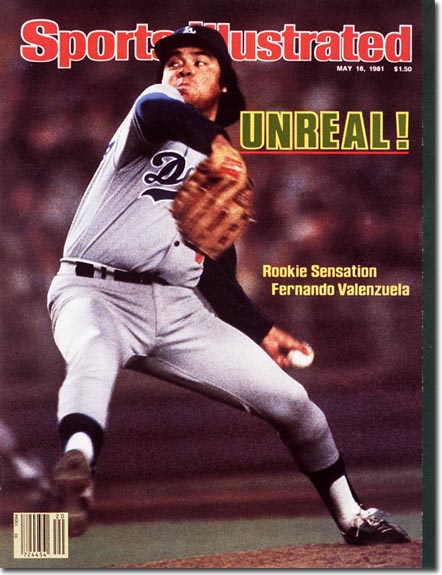
Fernandomania totally
swept America in 1981
But my elation was short lived. In the introduction, Haddad states, “…I am not a professional baseball writer. I am a fan.” And this book is absolutely not written by a real writer. Haddad recorded Vin Scully broadcasts during the time and made his own highlight tapes, incorporating his own commentary. So, he had a lot of firsthand information from that period. And he decided to throw them together into a book.  

The Dodgers had not won a World
Series since 1965; and had lost
their last two to the hated Yankees
There is a six page section on why he thinks The Bad News Bears is the best baseball movie ever. We are also treated to a sample of the Dodgers newsletter that he created at the time. A cowriter might have helped him shape this fan reminiscence into some semblance of a viable book. Instead, it’s kind of like reading through a scrapbook. He picks five games from each season to serve as representative of the year, with other miscellaneous stuff thrown in, like his thoughts on the movie, The Fan.


While I loved the subject matter (the 1974-1981 era in Dodgers history is woefully underreported), this is just about the worst book on the Dodgers that I have read.  It did wistfully remind me of my baseball card collecting days, but it just isn’t a very good tome. I hope someone else decides to delve into the Jimmy Wynn to Fernando Valenzuela days.

Glenn Burke 'invented' the high five as a
celebratory greeting to Dusty Baker.

Tuesday, July 10, 2012

Bob's Books - A Year at a Time by Walter Alston with Jack Tobin

Walter Alston managed the Brooklyn and Los Angeles Dodgers for twenty three seasons, beginning in 1954. He replaced the popular Chuck Dressen, who had demanded a multi-year contract after three consecutive first place finishes. (1951 was actually a tie for first). Team owner Walter O’Malley thanked Dressen for his services and pushed him out the door. The headline in the New York Daily News after the introductory press conference read, “ALSTON (WHO’S HE) TO MANAGE DODGERS.”

Alston brought Brooklyn its only World Series title in 1955 and would finish with a total of seven national league championships and four World Series wins. In 23 years. The Dodgers have won two World Series in the thirty-six years since he retired. And one of those was largely composed of players he had in his final season of 1976. He was elected to the Hall of Fame in 1983; a year before he passed away.

Walter Alston is a small town man who was a genuinely nice guy. Leo Durocher is famously (mis)quoted as having said ‘Nice guys finish last.’ Well, in this case, nice guys write bland autobiographies. Alston writes about his life in Darrtown, OH (where he lived his entire life) almost as much as he does about managing the Dodgers. Okay, that’s a slight exaggeration, but not as much as you might think.  He offers some insights into his pennant seasons in Brooklyn, but not a lot of them.


As a player, Alston played 13 seasons in the Cardinals minor league chain. He did get to bat once in the majors; for the Cards in 1936. He struck out! But he spent several years as a player – manager in the minors, which prepared him for his future career. Alston was a Dodgers rarity: he was a Rickey man whom Walter O’Malley took into the fold. As poorly as Harold Parrott thinks about the Irishman, (see my review of his book, The Lords of Baseball, for a very negative view of O’Malley), Alston thinks well of the long time owner.
The skipper does talk about Lou Johnson bailing out the 1965 season, and how unbelievable Sandy Koufax was even as the lefty’s arm was disintegrating from arthritis. But there’s just not as much information on his Dodgers teams as you would expect. Alston mentions that he believes if you don’t have anything nice to say, don’t say anything at all. Unfortunately, that makes for a rather boring book.

Tommy Lasorda had a heart attack partway through the 1996 season and had to retire. For forty-two and a half seasons, only two men managed the Dodgers. And both are in the Hall of Fame.  Since Lasorda stepped down, the Dodgers have had seven managers, none of who made it to the World Series.
Walter Alston was a symbol of the stability of the Dodger organization for parts of three decades. This book takes us through 1974, so he had two more years left as a manager. So, there is no discussion of Tommy Lasorda’s taking over the team after the 1976 season. Though I doubt Alston would have written anything negative, anyways.

Walter Alston was a Hall of Fame manager and a very good man.  I am a fan. This just isn’t a very interesting biography.

Monday, June 25, 2012

Bob's Books - Brooklyn Dodgers: The Last Great Pennant Drive, 1957 by John Norden, Jr.

Brooklyn Dodgers: The Last Great Pennant Drive, 1957, is a Kindle ebook by John Nordell, Jr. The book is essentially a  look at the season's box scores, with a short summary of the various games. I am a devoted Dodgers fan and love reading about the Brooklyn years. But this book, quite simply, is dull. It reads like someone, well, summarizing box scores. Without any of the numbers that give box scores their magic.

There’s not really much else for me to add. It’s the first book about the Dodgers I’m certain I’ll never re-read. This is one of my shortest reviews ever, but I don’t have much  more to say. If you want a good book on the subject, give a look at The Last Good Season: Brooklyn, the Dodgers and Their Final Pennant Race Together by Michael Shapiro.

Monday, June 18, 2012

Bob's Books - Bums No More by Stewart Wolpin


Bums No More, by Stewart Wolpin, is about THAT season. In the first forty World Series’, the Brooklyn Dodgers were 0-2.  And they were bad for a lot of those seasons, usually finishing in the second division. Larry MacPhail moved into the front office and righted the ship, with the team losing the 1941 World Series. A fellow named Jackie Robinson joined the team in 1947 and the Glory Years of Brooklyn baseball were underway. Between 1947 and 1956, the Dodgers appeared in six World Series. All were against the cross-town Yankees, and all were losses. Except for one. As the beloved once-Bums annually came up short in the Fall Classic, Brooklynites cried out, “Wait ‘til next year!” 1955 was finally Next Year.

Johnny Podres won 136 games for Brooklyn and Los
Angeles, including game two on his birthday. But none
were bigger than his complete game outing in the finale.
Subtitled The Championship Season of 1955, this book recounts the year that Gil Hodges, Duke Snider, Roy Campanella, Johnny Podres, Robinson and the other Boys of Summer won that elusive World Series. The first chapter gives a primer on the Dodgers. The stage is set for spring training in Vero Beach and the magical season is under way. First and foremost, this relatively slim book (130 pages, counting the index) is jam packed with photographs. The surfeit of pictures alone makes this book worthwhile for the Brooklyn Dodgers fan.

Ebbets Field, Jackie Robinson watching the Giants celebration of Bobby Thomson’s ‘Shot Heard Round the World’ as Ralph Branca walks away, head hanging, Duke Snider leaping in center field, lots of clubhouse shots, Sandy Amaros’ catch, fans in line for tickets, parades, celebrations: there are over 100 illustrations (all black and white, of course). It is a treasure trove of Brooklyn and the Dodgers in their lone season as World Series champs. If you believe in the magical aura of baseball in the ‘old days’ before overpriced superstars, and you have a feeling for the bond between fans and their home town teams back then, the picture of Ebbets Field on Pee Wee Reese night will give you goose bumps.

After a LONG run, Sandy Amoros grabs what might be the most important
catch in World Series history. Manager Walter Alston had just inserted
Amoros into the game as a defensive replacement that inning.

The writing does not come up short, either. You get a look at Walter Alston’s relationship with the team (he and Jackie Robinson were not friends). And you sense the looming storm as the Dodgers receive permission to play seven games in Jersey City. Only two seasons after Johnny Podres records the last out in game seven, the team would be the Los Angeles Dodgers.

The book contains many comments and remembrances from Brooklyn fans, most notably, Larry King. You get a sense of what the Dodgers meant to community and how Brooklyn lived and died with ‘Dem Bums.’ It ends with borough president John Cashmore talking about a new stadium and saying, “The Dodgers must never leave Brooklyn.” Well, they did.
As a fan of Dodgers history, I really liked this look at the 1955 season.  It’s an easy read and doesn’t take very long. But it captures the relationship between Brooklyn and the Dodgers and gives a look at the year the heartbreak ended: For a little while, at least. And you absolutely cannot beat the photo library.

Here’s a link to the New York Times story on game seven. The first sentence sums it up well.

Quite possibly, there has never been a more joyous
moment on the baseball field

Wednesday, June 13, 2012

Garvey, Lopes, Russell and Cey


On June 13, 1973, Steve Garvey, Dave Lopes, Bill Russell and Ron Cey  took what would become their familiar positions across the Dodgers' infield. They would play together for eight and a half years; the longest of any infield in major league history.

Second baseman Lopes would be traded to the A’s before the 1982 season, with first baseman Garvey (free agent to the Padres) and third baseman  Cey (traded to the Cubs) heading out of town for 1983. Shortstop Russell played in LA for all eighteen seasons of his career and had a (short) stint as manager.

The Dodgers won four western division titles and national league pennants during this time, going 1-3 in the World Series, losing to the A's in 1974 and the Yankees in 1977 and 1978 (Reggie Jackson INTERFERED!). The unstoppable force that was Fernandomania resulted in a win over the hated Yankees in 1981.