Search This Blog

Showing posts with label Jackie Robinson. Show all posts

Tuesday, April 14, 2015

Jackie Robinson Day is Tomorrow (April 15, 2015)

Tomorrow, April 15, is 2015 Jackie Robinson Day in MLB. I've written about Robinson several times here on the blog. The Dodgers are hosting the Mariners for a game on ESPN2. It's the 2015 Civil Rights Game and there will be all kinds of tributes.

Sharon Robinson (Jackie's widow), Don Newcombe, Sandy Koufax and Roy Campanella's daughter will all be involved in the throwing out the first pitch.

Tune in and remember Jackie. You can use the search line above to find all my Robinson, Newcombe and Dodgers related posts on the site.

BTW, I do pretty much all my posting these days over at my current blog, Almost Holmes. I'd like to free up some time do some more baseball writing here this summer, though.

Sunday, June 1, 2014

Bob's Books - 1947: When All Hell Broke Loose in Baseball by Red Barber

Barber and Robinson
Red Barber is a Hall of Fame baseball announcer who was broadcasting for the Brooklyn Dodgers during Jackie Robinson’s rookie year. From reading the cover and the dust jacket, you would think that 1947 – When All Hell Broke Loose in Baseball was about Robinson. But it’s actually not.

To be sure, there’s much about the man who broke baseball’s color barrier. But this book is really about the relationship between Branch Rickey, General Manager of the Dodgers and Larry MacPhail, part owner and essentially GM of the Yankees; and their teams, which squared off in the World Series.

The two men had a long history; first as friends, and by the end of 1947, as enemies. Rickey and MacPhail were great baseball men who had dramatic, lasting impacts on the game. For example, Rickey invented the minor league farm system, while MacPhail created night baseball. This book, in looking at the 1947 pennant races, tells their story.

Any Dodgers or Yankees fan interested in the 1947 editions of their teams will enjoy this book. And of course, followers of Jackie Robinson will be interested in hearing from the man who broadcast Dodgers games that year.

MacPhail and Rickey in happier days
At least as early as 1943, Branch Rickey began preparing the way for adding a black man to the Dodgers roster. A committee, headed by Larry MacPhail, was appointed by Major League Baseball to look into the issue of signing Negro players to contracts. The group voted 15-1 against the idea. Branch Rickey, the lone dissenter, stormed out and knew that he would be going it alone. MacPhail reportedly was angry with his former mentor for defying the group.

Days before the first game of 1947, Commissioner Happy Chandler suspended Brooklyn manager Leo Durocher for the season. Not only was it a blow to the Dodgers, who had finished two games behind the Cardinals in 1946, it was also a monkey wrench in Rickey’s plans for integrating baseball. For he was ready to install Jackie Robinson at first base for the Dodgers and he knew that the fiery Durocher would battle on Jackie’s behalf. And Larry MacPhail played a huge part in Leo’s suspension.

Barber takes us through that historic season, with Rickey and MacPhail usually at the center of the action. And they remain there to the last few pages. Barber also provides a look at the world of radio broadcasting in those days before television dominated the airwaves. In our modern era of ESPN highlights and digital channels, it’s like the Stone Age.

I find 1947 to be one of the most fascinating seasons in baseball history and this is a good accounting of it. However if you want a Robinson-centric look, this isn’t your best bet.

Thursday, May 15, 2014

Eddie Stanky - "Don't Come Home, Son"

"Dear Son:

Received your letter and am sorry to hear that you are so homesick.

You will notice that I did not forward any money for your passage to Philadelphia. The reason was not that I didn't have it to send to you, but that you were trying to tell me in your letter that you wanted to come home right away.

Edward, I have tears in my eyes while I'm telling you this, but if you do come home, please do not come to 915 East Russell Street. We do not want quitters in this family.

Your Mother"


That's Stanky next to Robinson, with Pee Wee Reese on the other side
and John (Spider) Jorgensen.
That's the 1947 starting infield during Robinson's rookie year. 
This is a real letter sent to Stanky as the 20 year old began his baseball career with the Philadelphia Athletics (yep, the A's started there, moved to Kansas City and finally finished the migration west in Oakland). Apparently the tough love approach worked, as Stanky did not come home.

In fact, Stanky was the opening day second baseman for the Brooklyn Dodgers in 1947, when Jackie Robinson broke the color barrier by starting at first. Stanky had told Robinson that he didn't like him but they'd get along and play together because he was his teammate.

And it was Stanky who jumped to Robinson's defense on that dark day in Philadelphia when manager Ben Chapman led his team in the most brutal taunting that Robinson endured that rookie season. Robinson later wrote that it was the closest he came to quitting. Stanky had jumped up and started screaming at the Phillies to pick on somebody who could fight back.

The scene (somewhat embellished) was included in '42'.

Stanky was far from the most athletically gifted player. Leo Durocher once said of him, "He can't hit, can't run, can't field. He's no nice guy ... all the little SOB can do is win." But he was a three time all star who lasted 11 years in the bigs and made it to three World Series': all with different teams.

Stanky had major league managerial stints in the fifties, sixties and seventies (for one game). He had a lasting impact as the head baseball coach at the University of South Alabama. Formerly a doormat program, he created a national powerhouse. Forty-three of his players made it to the major leagues and Stanky (nicknamed 'The Brat' as a player) changed his hard nosed philosophy to one of teaching the game and getting every player in-game experience. The ballpark at South Alabama is named Eddie Stanky Field.

Wednesday, May 7, 2014

Bob's Books - 'Off the Record' by Buzzie Bavasi

Buzzie Bavasi started out with the Brooklyn Dodgers, moved west with them to Los Angeles, was in on the ground floor for the expansion San Diego Padres and worked for Gene Autry with the Angels. With a break for World War II, he was in the baseball business from 1938 to 1984.

Off The Record is his memoir of a life in baseball. I gave five stars to Harold Parrott’s own baseball bio, The Lords of Baseball. Parrot worked with Bavasi in Brooklyn and LA and the book truly provided a look ‘behind the curtain.’

Bavasi’s book feels lightweight. As if you were talking over a few beers and he was telling stories. Which is fine. But it’s largely one short anecdote after another. There’s not a lot of detail or substance to the stories. Just sort of a “So I fired Durocher for badmouthing Alston. But Walter told me to hire him back the next day.” Then the next incident.

I’m always interested in books that tell about the Dodgers’ days in Brooklyn. Bavasi was there, and he does recount some things, but there’s not much to it. That’s not to say it isn’t without interest. He tells of his running the Dodgers’ minor league club in Nashua in 1946. While Jackie Robinson was playing in Montreal, Roy Campanella and Don Newcombe were integrating the New England League.

Bavasi tells of Jackie Robinson’s disingenuousness regarding his retirement instead of accepting a trade to San Francisco. And he certainly shares his thoughts on the changes in the game regarding players’ attitudes, agents and salaries (the book was published in 1987 and salaries were nothing like they are today).

This isn’t a bad book: but it feels like a single. And with Bavasi’s baseball resume, it could have been a home run. It falls in the bottom half of my Dodgers library.


Bavasi with Pee Wee Reese, Jackie Robinson and Roy Campanella: three Hall of Famers

Wednesday, February 27, 2013

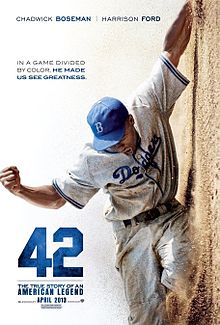
42 - Coming in Six Weeks

A story that Hollywood is LONG OVERDUE to tell. Jackie Robinson: American Hero.

Monday, September 24, 2012

42 - The Movie Decades Overdue

How in the world it has taken Hollywood SO LONG to make a film like this is incomprehensible to me. Jackie Robinson is one of the greatest heroes of the twentieth century and this is a story that every American should see.


Monday, June 18, 2012

Bob's Books - Bums No More by Stewart Wolpin


Bums No More, by Stewart Wolpin, is about THAT season. In the first forty World Series’, the Brooklyn Dodgers were 0-2.  And they were bad for a lot of those seasons, usually finishing in the second division. Larry MacPhail moved into the front office and righted the ship, with the team losing the 1941 World Series. A fellow named Jackie Robinson joined the team in 1947 and the Glory Years of Brooklyn baseball were underway. Between 1947 and 1956, the Dodgers appeared in six World Series. All were against the cross-town Yankees, and all were losses. Except for one. As the beloved once-Bums annually came up short in the Fall Classic, Brooklynites cried out, “Wait ‘til next year!” 1955 was finally Next Year.

Johnny Podres won 136 games for Brooklyn and Los
Angeles, including game two on his birthday. But none
were bigger than his complete game outing in the finale.
Subtitled The Championship Season of 1955, this book recounts the year that Gil Hodges, Duke Snider, Roy Campanella, Johnny Podres, Robinson and the other Boys of Summer won that elusive World Series. The first chapter gives a primer on the Dodgers. The stage is set for spring training in Vero Beach and the magical season is under way. First and foremost, this relatively slim book (130 pages, counting the index) is jam packed with photographs. The surfeit of pictures alone makes this book worthwhile for the Brooklyn Dodgers fan.

Ebbets Field, Jackie Robinson watching the Giants celebration of Bobby Thomson’s ‘Shot Heard Round the World’ as Ralph Branca walks away, head hanging, Duke Snider leaping in center field, lots of clubhouse shots, Sandy Amaros’ catch, fans in line for tickets, parades, celebrations: there are over 100 illustrations (all black and white, of course). It is a treasure trove of Brooklyn and the Dodgers in their lone season as World Series champs. If you believe in the magical aura of baseball in the ‘old days’ before overpriced superstars, and you have a feeling for the bond between fans and their home town teams back then, the picture of Ebbets Field on Pee Wee Reese night will give you goose bumps.

After a LONG run, Sandy Amoros grabs what might be the most important
catch in World Series history. Manager Walter Alston had just inserted
Amoros into the game as a defensive replacement that inning.

The writing does not come up short, either. You get a look at Walter Alston’s relationship with the team (he and Jackie Robinson were not friends). And you sense the looming storm as the Dodgers receive permission to play seven games in Jersey City. Only two seasons after Johnny Podres records the last out in game seven, the team would be the Los Angeles Dodgers.

The book contains many comments and remembrances from Brooklyn fans, most notably, Larry King. You get a sense of what the Dodgers meant to community and how Brooklyn lived and died with ‘Dem Bums.’ It ends with borough president John Cashmore talking about a new stadium and saying, “The Dodgers must never leave Brooklyn.” Well, they did.
As a fan of Dodgers history, I really liked this look at the 1955 season.  It’s an easy read and doesn’t take very long. But it captures the relationship between Brooklyn and the Dodgers and gives a look at the year the heartbreak ended: For a little while, at least. And you absolutely cannot beat the photo library.

Here’s a link to the New York Times story on game seven. The first sentence sums it up well.

Quite possibly, there has never been a more joyous
moment on the baseball field

Monday, June 11, 2012

Bob's Books - The Lords of Baseball by Harold Parrott

The Lords of Baseball is an insider’s look from Harold Parrott. Parrot was a sportswriter for the Brooklyn Eagle who became the travelling secretary for the Brooklyn Dodgers during Branch Rickey’s tenure. He moved to Los Angeles with the team and became the ticket manager: the same position he held with the San Diego Padres and Seattle Pilots, as well as promotions manager for the California Angels.

First off, there is some fascinating stuff. There are plenty of baseball books by players, managers and sports writers; even a few owners (hello, Bill Veek). Plus, the occasional tome from a baseball-side executive, like Parrot’s long time coworker, Buzzy Bavasi. But it’s rare to find an informative account from an operations person, like Parrott. Having said that, a caveat: Parrott is a bitter writer.
There is a caveat for this book: Parrot is a bitter man. His dislike of the owners, various and sundry individuals, and most certainly, Walter O’Malley, cannot be described as “thinly veiled.” It is palpable, jumping off of page after page. A description of O’Malley, when the owner was calling Parrot’s wife to try and get her to coax Parrott to take a promotion, sums it up well: “…he was the villain who had forced our dear Mr. Rickey to walk the plank.” It’s safe to say you’re not going to get a lot of unobjective commentary from the ex-reporter on that topic. Now, that’s not to say Parrott isn’t honest, accurate, etc… I subscribe to Bill Terry’s statement that “Baseball must be a great game to survive the fools who run it.” Major League Baseball succeeds in spite of itself. Richard Nixon famously said, “I gave them a sword, and they stuck it in and twisted it with relish.” This book is Parrott’s sword and he’s happily twisting it.

O'Malley (left) would drive
Branch Rickey out of Brooklyn
Parrott stories and insights into the behind the scenes stuff over three decades (the game has changed mightily) are attention worthy. Branch Rickey regularly outwitted Pirates owner John Galbraith on trades. When the Dodgers won a World Series, some employees were given rings. O’Malley required them to turn in a previous ring (if they had one before they could receive the new one. Apparently you weren’t allowed to have two rings.  And Parrott says that O’Malley was going to fire manager Walter Alston in 1974 and bring back Leo Durocher. But the Dodgers hit a winning streak, Alston was kept and the Dodgers went to the World Series. That’s a story I’ve only run across in this book.
A particularly great look inside is when Parrott tells the story of how he had to inform Leo Durocher in mid-season 1948 that The Lip was fired. Naturally, Parrott was worried. Durocher had been thrown out of the first game of a doubleheader and was in a foul mood, shaving in his office, razor in hand. And Parrot wants to hurry up and do the deed because…he was also afraid of Durocher’s fiery wife, movie star Larraine Day. He wanted to be done and gone before she made her regular visit to see her husband. Understandably, Durocher is pissed at Branch Rickey, who had given Parrott his instructions from a hospital bed. Which he apparently checked out of as soon as Parrot was gone: Rickey fled to his farm in Maryland. Durocher’s Dodgers kept winning and he wasn’t actually fired. Except that Rickey arranged for Horace Stoneham, owner of the Giants, to buy Durocher to be his manager. Afterwards, Parrott went into Durocher’s empty office. Day had taken everything personal, leaving behind just one thing. An autographed picture of Rickey, addressed to her. That was left in the toilet.

Durocher going from the Dodgers to the Giants in 1948 is on the record. But Parrott gives the reader so much more. The book is full of stories like that.
Rare photo of actual Seattle Pilots game play at
Sicks Stadium in 1969. Parrot gives the inside
story on how the owners set the franchise up
for certain failure through...
If you accept that the author has quite a bit of disdain for much of the subject matter, this is an excellent read and provides a great deal of information that you aren’t likely to find somewhere else. I would buy this just for the Durocher and Jackie Robinson stories alone. You also get a look at the old days of sports reporting and the newspaper business (the Brooklyn Eagle was printing FIVE editions a day: sometimes more when events warranted). Parrott had an adventurous life in baseball and it is fun to read about. I think this is the best ‘baseball insider’ book I’ve read yet.

...Dewey Soriano: the
original Frank McCourt

Saturday, May 19, 2012

A Life is not important, except in the impact it has on other lives - Jackie Robinson

Just after signing with the Dodgers; an act
that changed American society

In 1940, Joe Black was a senior at Plainfield High School in northern New Jersey. He was the star of the team, but his dream of playing in the major leagues was crushed one day in the team’s clubhouse. As Black relates:

“My junior year, I hit .357, my senior year I hit .380. And the scouts are signing guys, and nobody said a word to me. My foolish self, I went to a scout and said, “Hey, I’m the best hitter on the team. How come you don’t sign me up?” And he said the dreaded word. He said, “Colored guys don’t play in the big leagues.”

I said, “You’re crazy, man, you seen me playing baseball.” He said, “I didn’t say you can’t play baseball, but they don’t play in the big leagues.”

And they got silent in that clubhouse. I looked at the coach and the kids and I ran all the way home, about two and a half miles to my house from the field house and went up in the attic and I got my scrapbook. Hank Greenberg, Charlie Gehringer, Rudy York, Carl Hubbell, Harry Danning, Joe DiMaggio, Lou Gehrig – and he was right – there wasn’t a face of color there. And I tore them all up except Greenberg* and just laid in the bed and just cried.”

Joe Black had to play in the Negro Leagues because even though Hall of Fame Commissioner Kennesaw Mountain Landis said in 1943 that, “Each club is entirely free to employ Negro players to any and all extent it desires,” blacks were not allowed in the major leagues. Or even the minors.

But as a rookie in 1952, he helped pitch the Brooklyn Dodgers to the national league pennant. What happened between that shattering 1940 day in the clubhouse and the 1952 World Series? Just one thing: Jackie Robinson happened in 1947. Jackie Robinson changed lives. Joe Black’s life would have been very different had Robinson not smashed through major league baseball’s color barrier. The daily existence of a Negro League ballplayer was very different from that of a white man playing professional baseball. And by ‘different,’ I don’t mean ‘better.’

Joe Black pitching against the Yankees
in Game One of the 1952 World Series

Professional sports are full of narcissistic, self-absorbed, shallow, people. I can look to my favorite football team, the Pittsburgh Steelers, and see several people I don’t want my son to look up to. It’s easy to pick out famous athletes in sports and see a lack of admirable qualities. Heck, the phrase “Manny being Manny” embodies EVERYTHING Jackie Robinson did not represent. But yet again, another team is ready to accept Manny into the clubhouse.

Robinson’s own words are carved on his gravestone, “A life is not important, except in the impact it has on other lives.” He was a great ballplayer who lost a couple of early years to society's rampant racism. But he still managed to make it into the Hall of Fame. What he did between the lines, while impressive, is just a small part of Robinson's legacy. No professional athlete had such far reaching impacts, on and off the field, as he did. The term “hero” applies to very few athletes. But Jackie Robinson was one in every sense of the word.


On a side note: Back in 1884, Moses Fleetwood Walker played for Toledo in the American Association, which was a major league at the time. He is acknowledged as both the first black man to play major league baseball, and as the last one to do so before Jackie Robinson. Shortly after he left baseball, the de facto segregation of baseball was adopted by the various major and minor leagues and would continue until Robinson played at AAA Montreal in 1946.
Moses Fleetwood Walker

Thus, Robinson is recognized for breaking the color barrier, though Walker deserves mention.


*I wonder why Black kept Hank Greenberg's picture when he destroyed the others? A Hall of Fame slugger for the Tigers, the Jewish Greenberg had endured horrible insults and prejudice in the major leagues. Many believe of all the players who came before Robinson, Greenberg was subjected to the most racial abuse.

In 1947, the two men collided on a play at first base (Greenberg was with the Pirates by then). The next time Robinson reached first, Greenberg said, "I forgot to ask if you were hurt on that play." Robinson said that he was fine and Greenberg rplied, "Stick in there. You're doing fine. Keep your chin up."

Such a simple gesture, but a giant one in its context. Robinson called Greenberg his "diamond hero," and said, "Class tells. It sticks out all over Mr. Greenberg."

Robinson always remembered that kindness given in a season with very few of them.

Tuesday, May 8, 2012

May 7, 2012 - A Great Night at Dodger Stadium

Last night was the first home game since the new group took ownership and a new era of Dodger baseball began. Jackie Robinson's widow, Sharon, attended. And that handsome man throwing out the first pitch is Don Newcombe.
Big Newk was the major's first black pitcher after Jackie Robinson broke baseball's color barrier. Newcombe, who started out in the Negro Leagues, would be a Rookie of the Year and win a League MVP, a World Series ring and was the first Cy Young Award winner.

Newcombe (and Roy Campanella) helped ease Jackie Robinson's incredible lonileness during the pioneer's second season.


It's great to see Don Newcombe honored last night. In 1946, society said he couldn't play major league baseball, but he fought for his country in the Korean War in 1949 and 1950. I've said it before: what Jackie Robinson did in 1947 helped transform American society. And those who immediately followed, like Don Newcombe, helped him do it.


Heres's a great article on Newcombe.
http://mlb.mlb.com/news/article.jsp?ymd=20120412&content_id=28520284&vkey=news_mlb&c_id=mlb

Thursday, May 3, 2012

Bob's Books - The Era, 1947 - 1957: When the Yankees, the Giants and the Dodgers Ruled the World by Roger Kahn

In the forties and fifties, baseball was the national pastime. No other sport, professional or collegiate, was remotely as popular. And from 1947 to 1957, New York City, home to the Yankees, Giants and Dodgers, was the undisputed center of the baseball universe. Roger Kahn, best known for The Boys of Summer (the most compelling baseball book I have ever read), chronicles this glorious period of baseball in the aptly titled The Era, 1947-1957: When the Yankees, the Giants and the Dodgers Ruled the World.

In 1946, the Yankees finished seventeen games out of first place while the Giants were dead last in the NL at 61-93. The Dodgers, who finished tied with the Cardinals (but lost a best of three playoff series in two games), had won only one NL pennant since 1920. But everything changed in 1947, starting with Jackie Robinson breaking the color barrier.

In The Era, there were eleven World Series played. Nine of those World Series were won by a NYC team (7 by the Yankees, 1 by the Dodgers and 1 by the Giants.  The Yankees lost another one: only the 1948 matchup between the Cleveland Indians and Boston Braves did not feature a NYC ball club. Eleven seasons of baseball; eleven World Series; and a NYC team in all but one of them. And in seven of them, two NYC teams played each other!
My favorite Brooklyn Dodger: Pete Reiser. Leo Durocher said that
Willie Mays was  the geatest player he ever saw. But that the
oft-injured Reiser could have been .
So, of the twenty-two teams competing in the World Series between 1947 and 1957, seventeen of them were from NYC. Though the domination of these three teams would continue (the Dodgers, Yankees, or both would appear in the ensuing nine World Series, with the Giants making one appearance), the Dodgers and Giants would be based in southern California beginning in 1958: the Era of New York City baseball was over.
Jackie Robinson stealing home in the
1955 World Series
Kahn digs into the amazing cast of characters from the Era. Managers like Bucky Harris, Casey Stengel and Leo Durocher. Owners such as Branch Rickey, Walter O’Malley, Harry Stoneham and Larry MacPhail. And the players: oh my. Some shone briefly and flared out, like Pete Reiser, Bobby Thomson, Preacher Roe Vic Raschi and Bobby Brown. Others contributed great individual moments, like Bill Bevens, Don Larsen, Sandy Amoros and Johnny Podres. And some etched their names into baseball history, like DiMaggio, Mantle, Berra, Hodges, Snider, Robinson, Campanella and Mays.


'The Catch' by Willie Mays. This book tells you that
Joe Dimaggio thought that it was only the second
greatest he ever saw.
Kahn includes his own memories of being a NYC reporter then, along with contemporary interviews of notable participants. And he ties in events of the time, such as the House Un-American Activities Committee (before which Jackie Robinson testified) and Harry Truman watching the World Series from the White House. Every generation seems to romanticize the one that came before. But there is no denying that NYC baseball during The Era was simply amazing. And baseball changed when the Dodgers and Giants moved west. You could look it up (Casey Stengel reference, there). 

Did you know that the Yankees (bigotry) passed on Willie Mays? And the Dodgers (decelerating their affirmative action program) had also looked at him? Snider and Mays. Wow. Mantle and Mays. Stratospheric. And there is a great picture of young Mickey Mantle collapsing at Joe Dimaggio’s feet on a fly ball during the 1951 World Series.  The aging Joltin' Joe called  off the young Commerce Comet at the last moment. How good would Mantle have been if he hadn’t blown out his knee on that play?

This book is an excellent account of perhaps the most compelling time in baseball, on and off the field. It is well worth reading.
Mickey, Willie and Duke: 3 of the greatest
center fielders of all time in one city