Search This Blog

Showing posts with label Humphrey Bogart. Show all posts

Wednesday, August 28, 2013

Poster Thursday - Casablanca and Clooney's The Last Good German

I came across a tidbit for this Casablanca poster in a book I was reading last night. Warners didn't want to tip off the Bogart/Bergman relationship in this poster, so they 'generalized' it. And did so by lifting a picture from Bogie's Across the Pacific, released the prior year. Anybody who has seen Casalbanca (and if you have a pulse, you should have) knows that 'Bogie with a gun pose' doesn't really have anything to do with the film.

But that's really just an aside. Seeing the poster reminded me of my disappointment with George Clooney's The Last Good German. I rented this, expecting it to be a Casablanca type film. It's not. So why did I think that? Because of THIS poster. I think it's a cool poster. It's also a pretty direct copy of the Casablanca one above, wouldn't you say? The Last Good German was an okay film, if a bit slow paced (or even dull). Wikipedia said that the poster was an homage to Casablanca. Which is kinda cool, but certainly misleading. And in my case, it didn't deliver on the promise.

Tuesday, July 30, 2013

Bogie Marathon on TCM - Thursday!

Bogie had better gangster roles, but
Duke Mantee made him a keeper
Back in 1992, for no reason I can recall, this then-twenty five year old went to the fabulous Ohio Theater to see Casablanca on a big screen. I'd never seen a Humphrey Bogart movie before. I was mesmerized and I now own all but a few of his seventy-plus films.

New York City stage actor Humphrey DeForest Bogart headed west to Hollywood in 1930. He appeared in 12 films with little success and had actually returned to New York, gone back to Hollywood again and given up on Tinsel Town by1934. But Leslie Howard insisted that Bogie reprise his successful stage role of gangster Duke Mantee for the film version of The Petrified Forest in 1936. Bogart received rave reviews in the Bette Davis film and would stick in Hollywood (It's not overstating that without Howard, there would be no "Bogie." Bogart named his first born, daughter Leslie, after the actor).

Starting at 6 AM EST on Thursday morning, Turner Classic Movies is all Bogie, all day. TWELVE movies starring the film icon, a documentary and a couple shorts. If you're a Bogart fan, clear some space on that DVR. If you aren't a devotee, watch a few films and see what you're missing. I've included some trailers so you can check things out. The American Film Institute decreed Humphrey Bogart the greatest American male actor of all time. I agree.

6:00 AM - Bogart: The Untold Story
This one hour documentary is hosted by Stephen Humphrey Bogart, his son. It came out in 1996 as a cross promotion to Stephen's book, Humphrey Bogart, In Search of my Father. It's got some pretty good stuff in it.

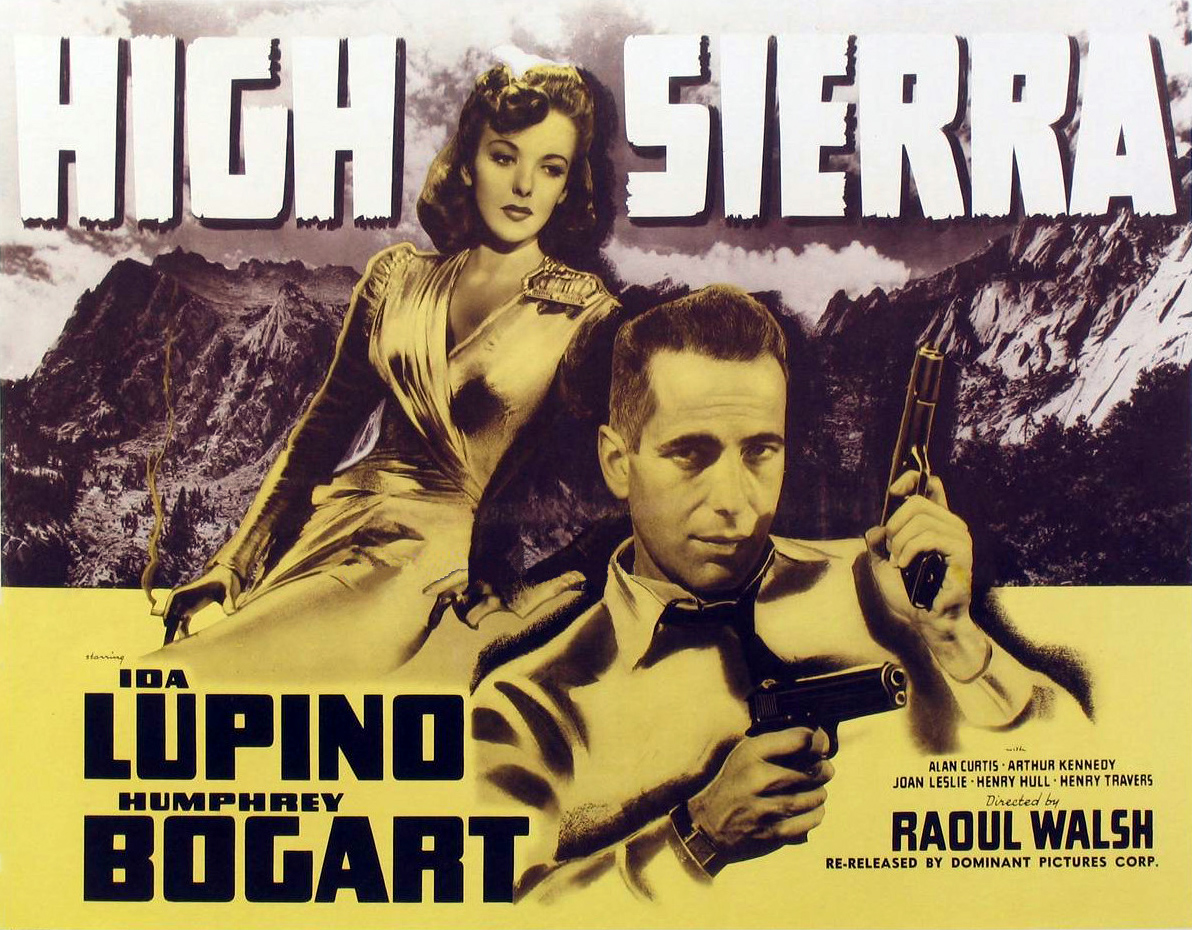
7:00 AM - High Sierra - 1940
http://www.youtube.com/watch?v=QePONKgWBZ0

Bogart would make 28 more films through 1940, some good, some bad, but none making him a star. Then, after George Raft turned down the lead in High Sierra, Bogie ended up playing Roy Earle, the killer with a soft spot. Bogart, opposite Ida Lupino, was a hit in the film with a screenplay by a promising screenwriter, John Huston (son of actor Walter). This remains one of Bogart's finest roles.

8:50 - We Never Sleep
This is an 8 minute documentary from 1956 on the Pinkertons, America's most famous detective agency (Dashiell Hammett was a 'Pink.') I don't believe Bogart is in this. It's just a thematic time filler.

9:00 AM - The Maltese Falcon - 1941
http://www.youtube.com/watch?v=7h19sLhvvlg

I mentioned that George Raft had turned down High Sierra. Well, he also passed on the Falcon, not wanting to do a remake with a first time director; John Huston. He reminded Jack Warner that the studio boss had promised him that he would only have to make "important pictures." Raft, who had been brought in to Warners as a top dog, was all but finished as a star, while Bogart beacme a legend. Without The Maltese Falcon, it's quite possible that Warners would have continued simply using Bogie as a screen filler. Check out the film Bogart made after High Sierra (The Wagons Roll at Night): Warners still didn't know what to do with him.

A movie everybody should see at least once. Dashiell Hammett's tale of Sam Spade is rightfully considered the finest private eye novel ever written. This, the third filmed version, is the best PI movie ever made. Rivals Casablanca for my favorite Bogart film. An absolute must see with a fantastic cast, including Sidney Greenstreet's film debut.

You can read about Raft's boost to Bogart's career in my essay, How George Raft Made Humphrey Bogart a Star. It's quite a tale: http://bogart-tribute.net/fan/byrne3.shtml

10:45 AM - To Have and Have Not - 1944
http://www.youtube.com/watch?v=cXy3tF5uD6A

Ernest Hemingway bet director Howard Hawks that Hawks could not make a good film out of his worst novel. Hawks changed some things around, but I think he won that bet. The 45 year old Bogie, in his third unsuccessful marriage, met his future fourth wife, 19 year old Lauren Bacall, during the making of this film. This was the one that took and Hollywood's most famous celebrity couple would make three more films together. One of Bogie's most enjoyable films to watch, with a couple supporting actors from Casablanca. Highly recommended.

12:30 PM - The Treasure of the Sierra Madre - 1948
http://www.youtube.com/watch?v=IIDlYsedmXo

Another John Huston-Bogart production, co-starring Huston's father, Walter. This tale of what greed does to a man features one of Bogie's most compelling performances as Fred C. Dobbs, a down on his luck American who hits the jackpot as a prospector in Mexico. John Huston makes an early cameo and the famous (though misquoted), "Badges? We don't need no stinkin' badges" comes from this film. Another must see in the Bogart library.

2:45 PM - Tokyo Joe - 1949
http://www.youtube.com/watch?v=JxGRK5JPoKU

Tired of having to take so many mediocre parts (Bogie famously said, "I've made more bad films than any actor alive"), Bogart formed his own company, Santana Productions. Though revolutionary (Jack Warner was furious, afraid other stars would follow suit and gain influence and bargaining power at the studios' expense), Santana was a money-loser and folded after seven films (five starring Bogart). Tokyo Joe was the first of his films for the company.

Bogie plays an ex-serviceman who returns to post-WW II Japan, where he had run a bar before the war. This is an okay film that fails to recapture the Casablanca mystique, but I rather like it. It doesn't make any of my best lists, but it feels like it had the elements to have been much better.

4:15 PM - Beat the Devil - 1953
http://www.youtube.com/watch?v=F5IFZSKimuM

A screwball caper, filmed in Italy, this was supposed to evoke memories of The Maltese Falcon: it doesn't. Directed by John Huston and co-written by Truman Capote, it's a muddled mess. There are some things worth watching, and it was the last time Bogart and Peter Lorre worked together, but it's quite a disappointing film, which is why it's in the public domain.

6:00 PM - In a Lonely Place - 1950
http://www.youtube.com/watch?v=CcMPHyOWjG4

Ah, that's better. Not one of Bogart's best known films from his star days, this is an excellent one, based on the best selling novel by Dorothy Hughes. Gloria Grahame is delightful as the female lead and Bogart's Dixon Steele is great. For a taut, suspenseful drama, this is just about Bogie's best. If you've never seen this movie, give it a watch. Bogart never quite played another part like this one. Bit of a hidden gem.

7:38 PM - The Luckiest Guy in the World - 1947
An Oscar winning short in the series, Crime Does Not Pay, I don't believe that this has any tie whatsoever to Bogart. Another thematic time filler, leading to...

8:00 PM - The Big Sleep - 1946
http://www.youtube.com/watch?v=VjJlBnfyiI4

Only Raymond Chandler's name stands alongside that of Dashiell Hammett's in the world of hard boiled noir. Black Mask writer achieved literary fame with his world weary private eye, Philip Marlowe. Bogart and Bacall teamed for this outstanding film. Certainly one of Bogie's best movies.


10 PM - Key Largo - 1948
http://www.youtube.com/watch?v=bs7Go24Rd8o

Another Huston/Bogart/Bacall film, with the great Lionel Barrymore and an Oscar winning performance from Claire Trevor. This is one of Bogie's best known films and features what I think is Edward G. Robinson's finest performance. And Robinson was a fine actor. If you've not seen this, you've missed out on a classic. Bogie and Robinson made five films together (four when Bogart was just a supporting actor) and all are worth at least one viewing. Bullets and Ballots is my favorite Bogie gangster flick.

11:45 PM - Stuff for Fluff
Some type of short documentary with no known Bogart tie.

12:00 AM - The Caine Mutiny - 1954
http://www.youtube.com/watch?v=2MeErathhsg

Based on Herman Wouk's novel, and shot with full cooperation from the navy, I love this film. It's got a fantastic cast and the court martial scene with Captain Queeg is perhaps Bogie's finest work. I am convinced that Tom Cruise's A Few Good Men drew on this movie. Perhaps the one Bogart film I most recommend to someone who hasn't seen it. Fred MacMurray is GREAT.

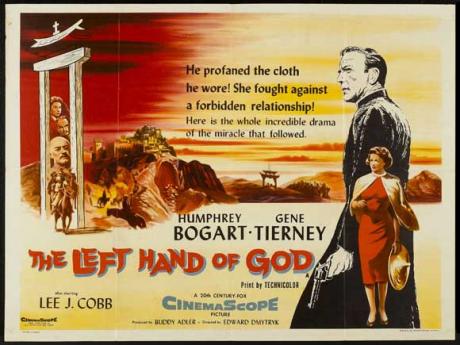
2:15 AM - The Left Hand of God - 1955
His third to last film, Bogart was clearly in ill health during the making of this one. Bogie plays a non-conventional priest in China. Gene Tierney, who suffered mental health issues, never forgot Bogart's support and kindness to her regarding this film. It's not bad and I kinda like it, but it's not one of the better films in this marathon. Worth a watch, though.

3:49 - Four Minute Fever
A non-Bogart related short on breaking the four minute mile barrier.


4:00 AM - The Harder They Fall - 1956
http://www.youtube.com/watch?v=hLWbbQcW5js

And the Bogart marathon comes to an end with his last film. He would die of cancer a half year after this was released. Bogie plays a boxing reporter who becomes sickened with Rod Steiger and the business. This was a bit of an expose of a popular untouchable sport (based on Budd Schulberg's novel).

A good film: I love Mike Lane's performance as a gentle giant in this one. And it's cool to see the contrasting acting styles of Bogart and Steiger.

SO...there you have it. There are many more Bogart films worth watching: All Through the Night, Deadline USA and Conflict are a few of my favorites among his less well known movies. and TCM's slate doesn't hit on the Warner gangster flicks of the thirties (often starring James Cagney or Robinson).  But you can't go wrong with most of these films.


Really, what do I need to add to this picture?


Thursday, June 20, 2013

Chain Lightning - Bogie in the Air

I believe I have mentioned that I LOVE these old posters
I finished watching Chain Lightning, a Humphrey Bogart film from 1950. I actually enjoyed this one more the second time around.
After years of complaining about being forced to make bad pictures, Bogie had formed Santana Productions, so he could call the shots. Chain Lightning, a Warner Brothers film, was sandwiched between two Santana flicks, Tokyo Joe and In a Lonely Place. Bogart plays Matt Brennan, a bomber pilot who signs on to test jet planes after the end of World War II. Chuck Yeager had broken the sound barrier in 1947 and super speed jets were a hot topic around the world. In fact, the film was dubbed and released in eleven countries.

Raymond Massey (seen a few years before in Bogie’s Action in the North Atlantic) played the industrialist looking to make some money, with Eleanor Parker as the love interest. Parker was a popular female lead at the time and would be nominated for an Academy Award in her next film, Caged. Richard Whorf is the idealistic engineer (and romantic rival). Whorf, about to move from acting to a successful career as a tv director, had starred in Midnight, back in 1934. Bogart was a gangster in the last film of his second attempt to make it in pictures. He gave up and went back to Broadway. If Leslie Howard hadn’t insisted Bogie play Duke Mantee in the movie adaptation of the hit play The Petrified Forest, Midnight might have been Bogart’s last film: and there would be no “Bogie.” While almost an important footnote, it's not much of a film.

It’s Whorf who holds this film together. Bogie is rather unlikeable and you wonder why Parker leans towards him and away from the much better man that Whorf is (girls always go for the bad guy!). It’s Whorf that gives the viewer someone to pull for while Bogart and Massey move the plot along.
Chain Lightning is full of experimental innovations (Bogie wears what looks like a B-movie space suit) and daring flight maneuvers. Along with the flashback footage of bombing missions over Germany, the flying scenes are neat, though the JA-3 jet plane looks like something out of a Buck Rogers serial.

There’s a big finish that sets everything right and softens Bogart (who sings in this movie!). With The African Queen coming the next year and only three years removed from Key Largo, Chain Lightning seems rather lightweight Bogart. And it is. But it’s not a bad movie. It slows a bit during the big test flight, but otherwise is well paced. This is in that category of Bogart movies that don’t make any of his “Best” lists, but offer a solid view. It’s not The Enforcer, but I’d put it ahead of Sahara.

Friday, April 20, 2012


The greatest movie ever made will return to theaters all over America on April 26. Seeing Casablanca on the big screen is a treat!

Friday, September 16, 2011

How George Raft Made Humphrey Bogart a Star - Part II

The careers of Bogart and Raft would be inextricably linked for the next three years and by 1943, Bogart was the biggest star in Hollywood and Raft was reduced to making a movie that attempted to copy the success of a Bogart film.

In 1939, Raft and Bogart made a forgettable film called Invisible Stripes. Released from prison, Raft goes on the straight and narrow while Bogart falls back into his bad habits. Circumstances force Raft to resume a life of crime but he manages to quit the gang and both Raft and Bogart are gunned down by other mobsters near the film’s end. It was one of seven (yes, seven) films Bogart made that year. He was shot to death in four of them (King of the Underworld, The Oklahoma Kid, The Roaring Twenties and Invisible Stripes); sentenced to be electrocuted in another (You Can’t Get Away Wirth Murder) and shot down after having been electrocuted and raised from the dead in another (The Return of Doctor X). He wasn’t exactly getting star quality parts.

Ironically enough, though he had only a minor part in Dark Victory, Bogie received good reviews for the one role when he was allowed to live. Bette Davis, star of Dark Victory, made six films with Bogart but strongly disliked him.

While Raft had star billing in Invisible Stripes, the number two male spot went to William Holden, with Bogart one slot below him. Bogart was annoyed, as this was only Holden’s second credited role, while it was Bogart’s thirty-second. It’s possible that this bad feeling in 1939 was at the root of their dislike for each other during the filming of Sabrina some fifteen years later.

Bogart Bit: Director Sam Spiegel wanted Bogart to play an American commando in the Oscar winning Bridge on the River Kwai, but Bogie was already committed to The Harder They Fall. The part went to Holden, instead.

In 1940, Raft would star in They Drive By Night, with Bogart playing his brother in this trucker film. Third-billed Ida Lupino turned out to be the star of the movie, breaking down in a memorable courtroom scene late in the film. Bogart was billed number four, with Ann Sheridan holding down the second spot. That same year, Raft turned down the lead in a gangster comedy called It All Came True and Bogart took the part. It wasn’t a very memorable film: just one of the seventeen he made from 1938 through 1940. Bogart was again billed below Ann Sheridan (she was the star; he was third bill).

Humphrey Bogart had worked in thirty-seven films in the previous eleven years, but it was in 1941 that Raft inadvertently made him a star. Back in 1938, a young John Huston had co-written the script to The Amazing Dr. Clitterhouse, starring Edward G. Robinson and Claire Trevor. Bogie had third billing as gangster Rocks Valentine (poisoned by Robinson in this appearance). In 1941, Huston worked with author W.R. Burnett on the screenplay for the latter’s novel, High Sierra. Raft turned down the movie, saying he didn’t want to play a gangster. Also, he didn’t like the fact that Roy Earle died at the end of the film. With that decision, Raft’s short stay at Warners began its decline and Bogart was starting to climb out of B movie purgatory.

The original Scarface
After Raft declined the part, the studio turned to Paul Muni. Muni had not made a film at Warners since 1937 and was fighting with the studio. Jack Warner seemed to be constantly battling his stars. Muni followed Raft and turned down the role. As it turns out, he had already made his last movie at Warner Brothers.

While Raft and Muni definitely refused the part, rumor has it that Cagney and Robinson also said no. With four of Warner’s top stars crossed off, Bogart was cast opposite Ida Lupino, who got top billing. There is speculation that Bogart was originally to receive the top spot but his recent brush with the House Un-American Activities Committee resulted in Lupino getting top billing instead. While Jack Warner certainly wouldn’t hesitate at such a move, Lupino was a hotter commodity after her turn in They Drive By Night and probably had more potential to move the film than Bogart at this stage in his career.

Regardless, Bogart received rave reviews as the criminal with a tender side. Critics and fans loved him and he enjoyed his biggest success since The Petrified Forest. Raft had blown a chance to star in a hit film. Something he would certainly regret as his career regressed.

Raft made only one movie in 1941, Manpower, costarring with Bogart and Marlene Dietrich. Raft wasn’t happy with Bogart and had him removed from the film just after shooting started. Bogart was upset but was not reinstated to the film. Edward G. Robinson replaced Bogie and the mild-mannered star ended up in a fight with Raft. The movie was mediocre. Raft was 0 for 2.

Edward G. Robinson helped create the Hollywood gangster as Rico in 1931’s Little Caesar. He played his last mobster, (Johnny) Rocco, in 1948’s Key Largo. In between, he had starred in Bullets or Ballots, Kid Galahad, The Amazing Dr. Clitterhouse and Brother Orchid, killing Bogart in all four of them. His success waned in the fifties but he had a final hurrah opposite Steve McQueen in 1965’s The Cincinnati Kid.


 Bogart, upset at losing Manpower, was even more upset when he was sent the script for Bad Men Of Missouri. He was to star as the eldest of the three Younger brothers, with Wayne Morris (who was actually billed above Bogart in Men Are Such Fools and The Return of Doctor X but featured below Bogie in China Clipper and Kid Galahad) and Arthur Kennedy (fresh off High Sierra, his second film). The female lead was played by future Oscar winner and Mrs. Ronald Reagan, Jane Wyman. Legend is that Bogart wrote “Are you kidding me?” on the script and sent it back to Jack Warner, who quickly suspended him. Dennis Morgan replaced Bogart in the lead.
Before Elvis Presley, Wayne Morris (left) was Kid Galahad
Bogie Bits: Not long before he died, Bogart said that he made more lousy pictures than any other actor in history. And though it usually wasn't his fault, he did make an awful lot of stinkers. There are several that could claim the title of most rotten tomato (I can't imagine myself ever watching Swing Your Lady a second time), but you'd have to work pretty  hard to top The Return of Dr. X.

Bogie is a scientist who had been executed. He is brought back from the dead and needs to kill people for their blood in lieu of the synthetic blood he was first using. Wayne Morris (see the tie-in here. Not a completely irrelevant jaunt) is the hero of the film.

This was Bogie's only science fiction/horror film and he has a skunk stripe in his hair. It is a classic bad B sci fi film from the era. He rarely talked about it as he considered this one of his worst movies. It was presented as a sequel to the successful Doctor X film, but the actual similarities ended at the title.

I don't give that bunny much of a chance...


Wednesday, April 13, 2011

How George Raft Made Humphrey Bogart a Star - I

OK, I’ll admit that the title is a bit of an over-simplification. However, in the annals of Hollywood, never has one actor so torpedoed his own career, while pushing another actor upward at the same time. Let’s take a look at this story.

George Raft grew up in Hell’s Kitchen, New York, where he was a childhood friend of Owney Madden, who would become a powerful mobster in the days of Prohibition. Raft toyed with being a boxer and then taught himself to dance. He hit it big in Vaudeville in the early twenties and was a top dancer. At the same time, he hung out with professional gangsters, gaining access to them through his friendship with Downey. He studied how they walked and talked, and mastered the art of imitating their mannerisms.

After appearing in a few films as a dancer, he broke through in 1932. Long before Rod Steiger and Al Pacino played Capone roles, Paul Muni made a classic gangster film: Scarface – Shame of a Nation. Raft had a part as Rinaldo, a coin-flipping gunman. Raft played a great gangster because he knew the real deals and used mobsters such as Arnold Rothstein as models. Raft received strong reviews for his character.

He had the lead in a 1935 version of Dashiell Hammett’s The Glass Key, though it is Alan Ladd’s portrayal in 1942 that is remembered today. Several elements of The Glass Key can be found in the Coen Brothers’ Miller’s Crossing, one of the finest gangster films of the past forty years.

In 1937, Raft turned down the role of Baby Face Martin in Dead End. He felt that Martin wasn’t sympathetic enough, and he didn’t like the way Martin’s mother slapped him in the movie. Dead End was a very successful stage play and MGM was making a big budget adaptation. It would have been a good role for Raft.

Instead, Bogart was cast as Martin and got good reviews. The film was directed by William Wyler, who would tap Bogart late in his career for the lead role in The Desperate Hours. So, Raft rejects a role and Humphrey Bogart takes it. We are on the cusp of a pattern developing.

George Raft signed with Warner Brothers in 1939 as part of their “Murder’s Row.” Paul Muni, James Cagney and Edward G. Robinson were already at Warners and gave the studio the strongest lineup of tough guy leading men. Muni’s days at Warners were winding down and Raft had every opportunity to supplant Cagney and Robinson to become number one. Meanwhile, a guy named Bogart played supporting roles in which he was usually gunned down by the star (maybe he could have headed up Warner’s “Murdered Row”).

Word is that as soon as Raft signed with Warners, he bumped Bogart out of the “Hood Stacey” role in Each Dawn I Die, with James Cagney.  Each Dawn I Die holds up well today but might have been even better with Bogart instead of Raft. 
Or maybe not.Raft played his part well.

Continued in Part II